Peaches Casino Login: Safe And Fast

In Netherlands, you'll find clear steps here: account access, secure login, recovery in case of errors, and smart limits.

Play Now!
Slot Fortune Gems 2

Table of Contents

  • The Dog House Megaways Slot
  • Lucky Joker 10 Extra Gifts Slot
  • Sword of Ares Slot
  • Floating Dragon Hold & Spin Slot
  • Leprechaun Riches Slot
  • Fruit Coctail Slot
  • The Dog House Megaways Slot
  • Sword of Ares Slot
  • Fruit Million Slot
  • The Dog House Megaways Slot
  • Fruit Box Slot
  • Big Fisherman Slot
  • Seven Books Unlimited Slot
  • Casino Peaches Fortune Slot
  • Sword of Ares Slot
  • Floating Dragon Hold & Spin Slot
  • 9 Mad Hats Slot
  • Floating Dragon Hold & Spin Slot
  • Big Bass Splash Slot
login 1

Casino Peaches Login: Where To Start

Before you try to log in to Casino Peaches, a little preparation helps. Imagine you just wanted to make a deposit, but suddenly you see a message that your session has expired. Often it's not a big problem, but a small detail: an outdated tab, an incorrect keyboard language, or automatically filled-in data that is no longer correct.

Play Now!

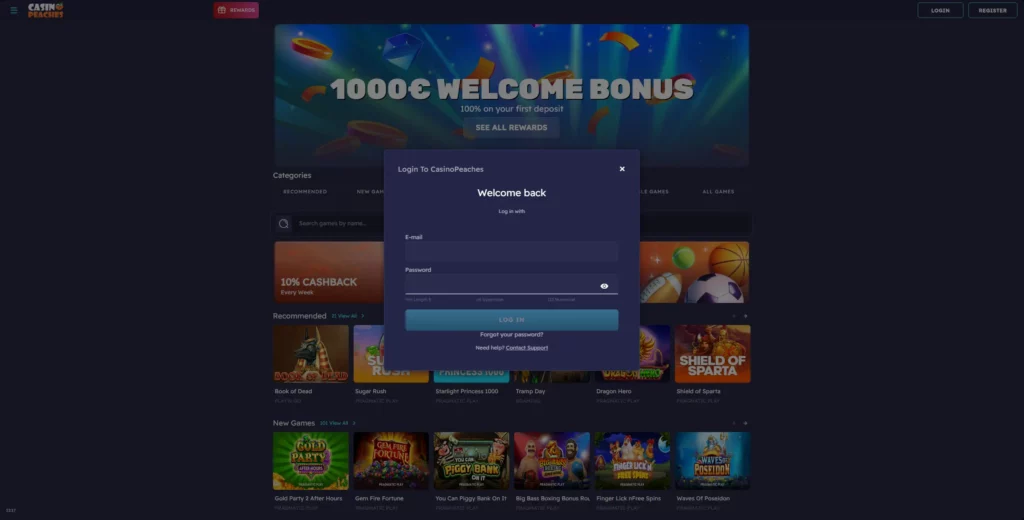
Start with three checks. 1) Use the same email as during registration and type the password calmly once, without auto-fill. 2) Check whether caps lock or language settings have not changed. 3) Look in your account settings to see if your basic data is still current, so you don't get stuck during an extra confirmation. The environment is intended for players in Netherlands who comply with local rules and are 18 years or older, so it pays to keep your profile neat and consistent.

login 2

Login Without Hassle On Mobile And Desktop

Many players switch between phone and laptop. Imagine you want to check your balance on the go, while your mobile switches from Wi-Fi to 4G. Then a session can break off and it seems as if your access fails, while it's actually the connection.

Play Now!

On desktop, it usually works best with one up-to-date browser and as few extensions as possible that block scripts. On mobile, it helps to close heavy apps and restart the device if everything feels slow. Do you get an error message? Close all tabs, open a new window and enter your details manually. This prevents an old password or an incorrect capitalization from hindering you. If you use a shared device, always log out and delete saved data, so that no one accidentally ends up in your session later.

Common Access Errors And Quick Fixes

If access fails, it's tempting to click through quickly. Imagine you come back after a break and suddenly see an extra check, while yesterday everything went smoothly. Usually, this is a signal that the system detects something different: new device, new location, or a different connection.

Play Now!
login 3

Work in this order. First: check your internet and try again once. Then: clear cache and cookies, because old session data often interferes. Next: temporarily disable blockers (adblockers, privacy tools) that may prevent pop-ups or security windows. If the problem persists, use the standard recovery route to renew your access and immediately choose a unique password that you do not use anywhere else.

Forgot Password Or Lockout After Attempts

A lockout often occurs after multiple quick attempts. Imagine you are in a hurry, try something three times, and then see a lockout. The system slows you down to prevent abuse. Wait a moment, then try again with one calm attempt, or go directly to recovery instead of guessing.

Choose a new password that is long enough and remains logical to you, for example, a phrase you remember with extra characters. Store it in a password manager or write it down offline in a secure place – but avoid duplicate systems, as that's where things go wrong.

Two-Step Verification and Device Control

Extra security often prevents greater frustration. Imagine receiving a notification about an attempt from an unknown device. Even if it's nothing, you want control. With two-step verification, unwanted access becomes more difficult, and you see what's happening more quickly.

Enable 2FA and immediately test if you can actually use the codes. Store recovery codes separately (not on the same device) and check your device list: remove devices you no longer use. These are small steps that prevent a lot of trouble.

Browser Settings That Can Block Login

Sometimes it's not your account, but your browser. Imagine seeing a blank screen after entering your details. Cookies or scripts may be blocked. For this session, slightly lower the strictest blockers and try again.

Also pay attention to automatic translators. They can misinterpret buttons and fields, especially with security pop-ups. Disable them during login and only re-enable them once you're in.

Notifications About Sessions, Cookies, and Time Limits

A session does not remain open indefinitely. Imagine pausing to cook and then coming back: you have to reconfirm. That's normal. If you log out extremely often, check if your browser isn't clearing everything upon closing, or if energy-saving apps are closing applications.

Plan short play sessions with clear breaks. That's calmer and prevents you from getting a timeout in the middle of an action.

Account Management: Profile, Limits, and Communication

Once you're in, it's about more than just playing: it's also about control. Imagine wanting to use a feature but realizing your profile isn't complete. You'll experience delays precisely when you wanted to proceed quickly.

Set up your account with three points: profile data, notifications, and limits. Profile data keeps your access stable, notifications prevent you from missing transactions, and limits help you stay within your own budget and time. The goal is simple: fewer surprises, more control.

Updating Profile Data Without Hassle

If you have a new number or email, update it immediately. Imagine having to confirm something later and the message goes to an old number. A simple step suddenly becomes difficult. Therefore, keep your basic information current and occasionally check if everything is correct.

Avoid creative variants or abbreviations in personal data. Boring is good here: the more consistent, the less friction if verification or recovery is ever needed.

Notifications, Newsletters, and Peace in Your Inbox

Too many notifications is a classic. Imagine waking up to a full inbox after an evening of playing. Not convenient. Therefore, enable transaction notifications, but limit marketing notifications to what you truly want.

You can also organize messages with filters so you don't miss important confirmations. And if you want no distractions for a while: temporarily disable notifications, instead of permanently blocking everything.

Time-Out, Self-Exclusion, and Return Plan

Responsible gaming is a fixed component of modern platforms. Imagine noticing you're playing more often than you intended. A time-out then helps you distance yourself without arguing with yourself. Choose a break you take seriously and plan in advance what you'll do during that time.

If you opt for self-exclusion, treat it as a clear boundary. Note why you did it and create a return plan: lower limits, shorter sessions, and a fixed stop time. That sounds simple, but it often works precisely because it's concrete.

Payments and Withdrawals: What You Arrange in Advance

Transactions only feel good if you know what you're doing. Imagine wanting to withdraw winnings and discovering too late that your chosen method is not suitable for withdrawals. You can prevent this by deciding in advance which route you will use.

Keep it practical: choose a method in your own name, check your limits, and see if you can use the same route for deposits and withdrawals if requested. Processing time often depends on bank procedures and security checks, so don't count on 'always instant,' but rather 'dependent on method'.

Item

What You Do

What to Watch Out For

Common Issues

Quick Solution

Deposit

Choose method and confirm

Own name, balance, limit

Confirmation pending

Close window and try again with a stable connection

Withdraw

Select method and amount

Verification, daily limit

Status remains 'in processing'

Check notifications and complete open checks

Identity Check

Upload requested documents

Legibility, validity

Photo blurry or cropped

Take new photo in daylight, without reflection

Limits

View minimums and maximums

Minimum, maximum, limits

Rejection due to amount

Adjust amount within limits or choose alternative

Security

Confirm transactions

2FA, device trust

Code not coming through

Check device clock and use backup codes

Making a Deposit Without Surprises

Depositing is usually simple, but limits define the experience. Imagine entering an amount and seeing an error because you're above your own limit. That's not a bug, but protection. Adjust the amount and only increase limits if it fits your budget.

After depositing, briefly check your transaction overview. If you see a delay, wait a moment before trying again, otherwise you'll create duplicate attempts that will need to be rectified later.

Requesting Withdrawals and Remaining Patient

Withdrawals sometimes require extra steps. Imagine that after a good session, you want to cash out everything immediately and you receive a request to confirm details. That feels like a hurdle, but it prevents errors and misuse.

Submit one request at a time and note the date and amount. If you don't see an update after a reasonable period, contact support with clear details: what you did, what you saw, and on which device.

Currency, Budget, and Simple Administration

Overview doesn't have to be complicated. Imagine that after a week, you no longer remember what you deposited and withdrew. Then it becomes difficult to feel your limits. Therefore, keep a simple note: date and amount, plus one short comment like "play budget".

Choose one currency for your own administration and note the final amount you actually see. This way, you avoid confusion due to conversions.

Support for Payment Problems: What to Prepare

If you need help, preparation helps. Imagine writing to support with just "it's not working". Then a questionnaire follows. Immediately prepare: date and time, method, amount, and the exact message (without sharing sensitive codes).

Ask for a step-by-step plan: what you can do now, what you better not do, and when you should check again. That keeps the conversation short and effective.


Responsible Gaming and Safety Routine

An account is not just an access point; it's also your dashboard for responsibility. Imagine you notice you're staying longer than planned. Then it's time to implement a routine: break, limit, and a clear stopping point.

Use a session timer, set deposit and time limits, and be extra careful on shared devices or public networks. If you feel restless or return faster after a loss, immediately distance yourself: log out, set a time-out, and choose peace. In an 18+ environment in Netherlands, this is part of sensible use, just as you also maintain a budget for other hobbies.

Mini-Checklist for Access and Control

Imagine you want to play in five minutes. Then a mini-check helps: device charged, stable connection, recovery options up-to-date, 2FA active, and limits set. In doubt? Choose lower and adjust later, not the other way around.

FAQ

Imagine you're about to cash out and suddenly realize you don't know your password anymore. Use the recovery option, choose a new password that you will really remember (preferably unique), and then log in once more to test. Immediately update your recovery settings, so that next time you are not dependent on one device or one email.

Usually, a block occurs because you try too often in a short period. Imagine you're in a hurry and type quickly three times: the system then puts a brake on it. Wait a moment, check keyboard language and caps lock, and then calmly follow the verification steps. If the problem persists, contact support with the date, device, and the exact message, so you don't keep trying endlessly.

Imagine you're suddenly working on a new laptop or you're on a different network. The system might then ask for extra confirmation, so no one else can simply gain access. Complete the check, then take a look at your device list and remove devices you no longer use. Store recovery codes in a safe place that is not on the same device.

If you notice you're coming back too often, a break helps more than good intentions. Imagine that after a loss, you immediately want to 'win back' - that's precisely the moment to choose a time-out. Go to your account settings, select the desired pause duration, and confirm that choice. Then make a small plan for the period without playing: catch up on sleep, plan other activities, and set stricter limits upon return.

Start with the basics: limits, name details, and whether there's any open verification. Imagine clicking twice because you think nothing happened - that just makes it unclear later. Submit one request at a time, check your transaction overview, and wait for updates. If there's no change after a reasonable time, gather the date, amount, and message, and only then contact support.

Imagine quickly opening your account on someone else's laptop. If you don't log out, the next user could access it. Therefore, always log out, preferably use a private window, and do not save passwords in an unfamiliar browser. Avoid public Wi-Fi for transactions and enable two-factor authentication for extra security.

A good sign is when you start shifting your own agreements. Imagine saying 'just one more round' and suddenly an hour has passed. If you play longer than planned, return faster after a loss, or feel restless without playing, immediately take a break and set stricter limits. Consider a time-out or self-exclusion and, if necessary, talk to someone about it, so you don't keep negotiating only in your head.

Play Now